AI Rework: Why Managers Are Fixing Everyone Else’s AI Output

AI has made it dramatically faster to produce a first draft.
A report that once took several hours can now appear in minutes. The same is true for presentations, research summaries, campaign ideas, financial models, client proposals, and code.
But faster drafts do not automatically produce faster decisions or better work.
The draft still has to be understood, checked, corrected, approved, and turned into something the organisation can safely use. When employees cannot complete those steps themselves, the remaining work moves to managers and senior specialists.
This is the hidden cost of AI rework.
The core problem: AI has reduced the cost of producing a plausible answer. It has not reduced the cost of deciding whether that answer is correct, relevant, and ready to use.
What is AI rework?
AI rework is the additional human work required to turn AI-generated output into an accepted result.
It includes:
- correcting factual or logical errors;
- rewriting work that missed the actual task;
- adding missing context;
- checking calculations, claims, sources, or code;
- resolving conflicting outputs;
- returning work for another iteration;
- repairing mistakes found after handoff.
Not every review is rework. Important decisions should be reviewed regardless of whether AI was involved.
The problem begins when the same preventable weaknesses repeatedly reach the reviewer because the author did not understand the task, define the quality standard, or verify the result before submitting it.
AI saves time. Then teams spend part of it again.
In a 2026 Workday study of 3,200 employees who actively used AI, 85% reported saving between one and seven hours per week. However, nearly 40% of those time savings were lost to correcting errors, rewriting content, and verifying AI output. Only 14% consistently reported clear positive outcomes from AI use.

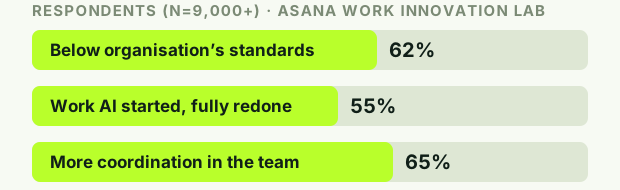
Asana’s Work Innovation Lab reported a similar pattern across more than 9,000 knowledge workers:
- 62% said AI produced work that did not meet their organisation’s standards;
- 55% had completely redone work started by AI;
- 65% said AI created more coordination work between team members.
These are vendor-sponsored, self-reported surveys. They should not be treated as precise measurements of every company’s AI return.
But they point to the same operational problem:
Production capacity is increasing faster than teams’ ability to evaluate, absorb, and approve the resulting work.
AI does not always remove the bottleneck. It often moves it.
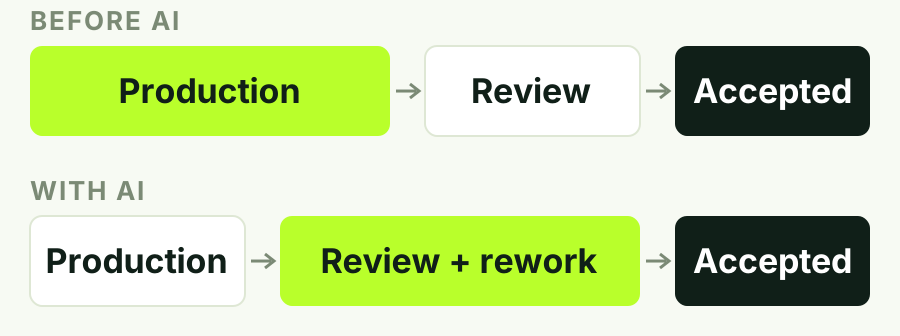
The first draft became cheaper. The accepted result did not.
Before generative AI, producing a detailed report, proposal, analysis, or piece of code usually required time and some understanding of the task.
Now a person can generate something polished without fully understanding:
- what problem is being solved;
- which assumptions matter;
- what evidence is required;
- what a good result should contain;
- what could go wrong if the answer is used.
This creates a gap between apparent completion and actual readiness.
The output looks finished. It may be well structured, professionally written, and confident.
But someone still has to decide:
- Did it solve the right problem?
- Is the reasoning valid?
- Are the claims supported?
- What information is missing?
- Does it meet the required standard?
- Can we act on it safely?
Those are not formatting questions. They are judgment calls.
Why AI rework moves upward
AI rework often lands on managers, partners, and senior specialists because they remain responsible for the final result.
An employee can now create more material in less time. But if their ability to evaluate that material has not improved at the same rate, the team has not gained autonomous productivity.
It has produced more work for the review queue.
The reviewer must then reconstruct what happened:
- What was the original task?
- Why was this approach chosen?
- Which assumptions were made?
- What came from AI?
- What has been independently checked?
- What remains uncertain?
- Can the author explain and defend the conclusion?
When the author cannot answer these questions, the manager is no longer reviewing the work.
The manager is completing it.
Research published at CHI 2025 supports this shift in the nature of knowledge work. In a study of 319 knowledge workers, researchers found that generative AI moved critical-thinking effort towards information verification, response integration, and task stewardship. Higher confidence in AI was also associated with less critical-thinking effort.
In other words, AI may reduce the effort required to produce an answer while increasing the importance of knowing how to evaluate it.
Individual productivity is not organisational productivity
Most AI productivity claims measure the person creating the first output:
- How quickly was the document drafted?
- How many options were generated?
- How many lines of code were written?
- How many tasks were completed?
But an organisation does not receive value when a draft is generated.
It receives value when the work is accepted and used.
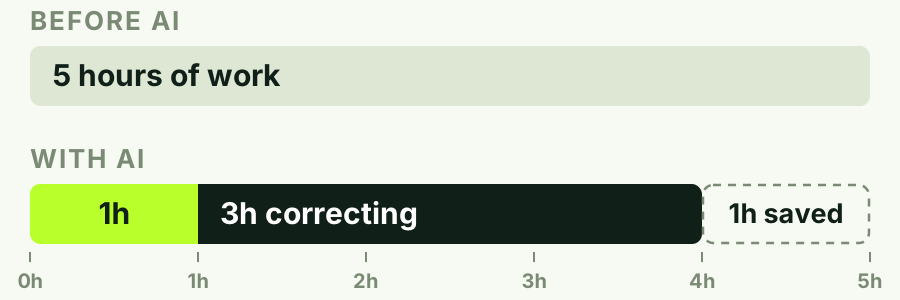
A five-hour task completed in one hour is not an 80% productivity gain if a manager later spends three hours correcting it.
It may still be a gain. But it is a much smaller one.
If the work also creates additional meetings, review cycles, client corrections, or downstream errors, the apparent gain can disappear entirely.
How to tell whether your team has an AI rework problem
Do not measure only AI adoption, prompt volume, or self-reported hours saved.
Measure what happens between the first draft and accepted work.
| Metric | What it reveals |
|---|---|
| First-pass acceptance rate | How often work is accepted without substantial correction |
| Review iterations | How many times work moves between the author and reviewer |
| Senior review time | How much expensive specialist time each accepted result requires |
| Rework after handoff | How often supposedly finished work must be reopened |
| Downstream defects | How often clients or other teams find problems that internal review missed |
These metrics reveal whether AI is creating more usable work or simply more work to inspect.
Why better prompts are not enough
Poor prompting can certainly create poor output.
But prompting is only one part of the workflow.
A detailed prompt cannot compensate for someone who does not know:
- what the real task is;
- what quality looks like;
- which claims require verification;
- which risks matter;
- when the AI should not be trusted;
- whether the final answer is good enough to pass on.
A person can write an excellent prompt for the wrong task.
They can also receive an excellent-looking answer that should not be used.
Prompting improves the request. Judgment determines whether the result deserves to pass.
How teams can reduce AI rework
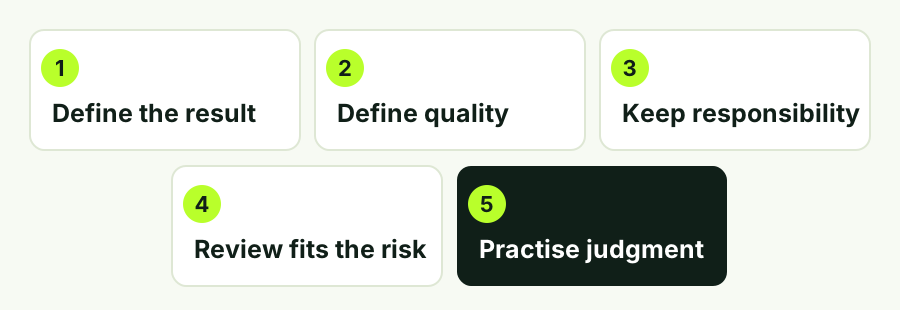
1. Define the result before using AI
Before generating anything, the employee should be able to state:
- the decision or outcome required;
- who will use the work;
- the important constraints;
- what the result must contain;
- what would make it unacceptable.
The first step is not writing a prompt. It is understanding the task.
2. Define quality before reviewing the answer
Without explicit quality criteria, review becomes subjective and inconsistent.
Teams should agree on what good work looks like before production begins. This may include required evidence, accuracy thresholds, risks to check, formatting rules, or questions the final work must answer.
3. Keep responsibility with the author
The person submitting AI-assisted work should be able to explain:
- why it answers the task;
- which claims were checked;
- which assumptions were made;
- what remains uncertain;
- where specialist review is still required.
Using AI does not transfer responsibility to the tool or to the manager.
4. Match the review process to the risk
A private brainstorming document does not require the same controls as a financial recommendation, legal document, client deliverable, or production code change.
Teams need clear rules for what can be self-checked, what requires peer review, and what must be approved by a qualified decision owner.
5. Train judgment through practice
Employees do not develop judgment by watching another presentation about AI.
They develop it by making decisions, committing to an answer, receiving specific feedback, seeing what they missed, and applying the lesson to the next situation.
The goal is not simply to help people generate more work.
It is to help them recognise what is good enough to use and take responsibility for the final result.
AI can make the draft. Your team still has to make the call.
The companies that gain the most from AI will not necessarily be those with the highest adoption rates or the largest number of generated outputs.
They will be the companies whose people can:
- define the real task;
- recognise weak reasoning;
- verify important claims;
- make decisions under uncertainty;
- take ownership of what they pass on.
Without those capabilities, AI can turn managers into the final human repair layer.
With them, faster production can become faster, better work.